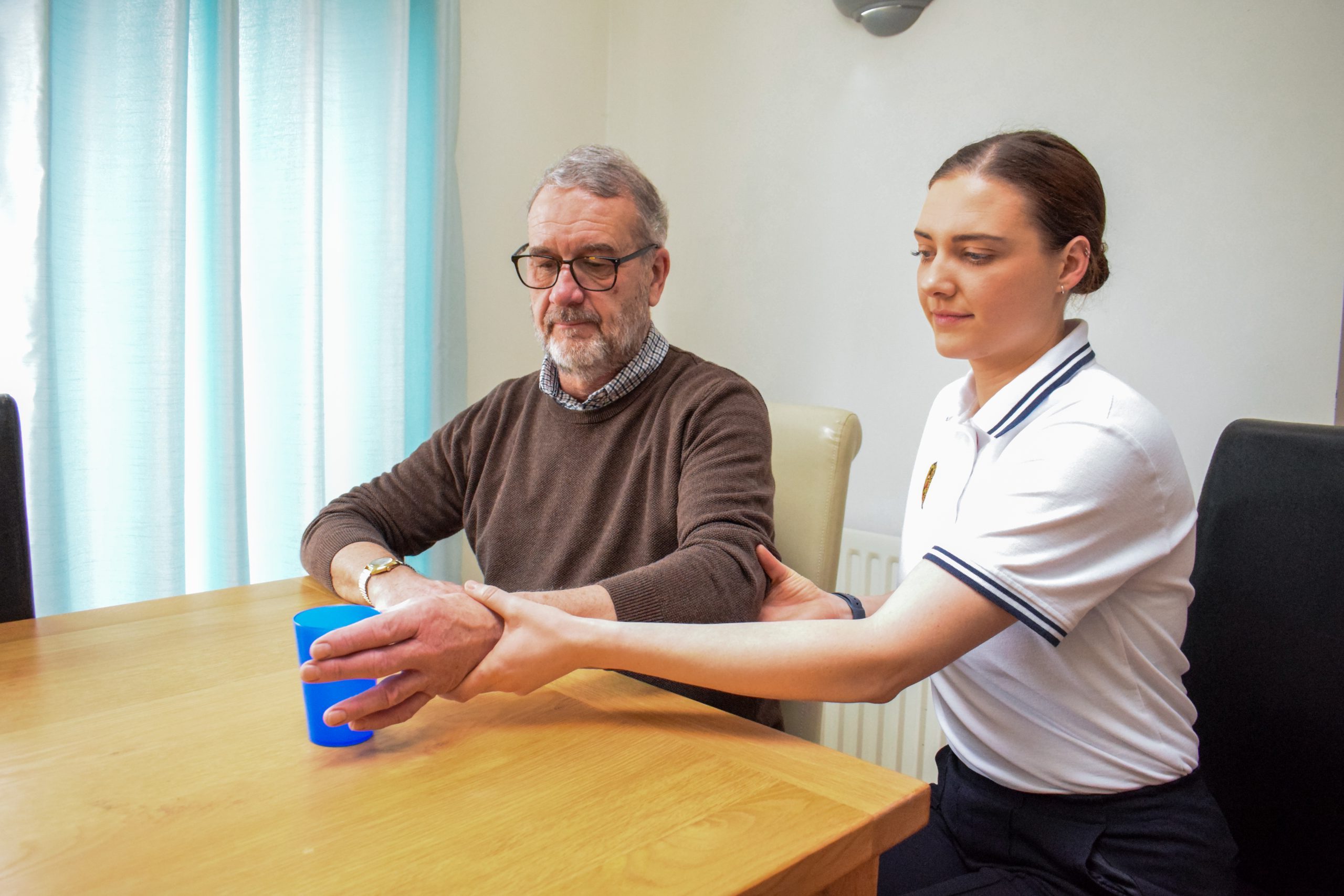
Parkinson’s disease is characterised by a progressive reduction in the amplitude of movement — steps become smaller, arm swing diminishes, handwriting shrinks, and facial expression reduces. This phenomenon, known as hypokinesia, arises from impaired basal ganglia function and a disruption to the internal calibration of movement size.
LSVT BIG (Lee Silverman Voice Treatment — BIG) is a physiotherapy programme specifically designed to address hypokinesia by training individuals to produce large-amplitude movements, effectively recalibrating the brain’s perception of normal movement size.
The Science Behind LSVT BIG
People with Parkinson’s disease consistently underestimate the size of their movements — a large step feels enormous even when it looks normal to an observer. LSVT BIG works by repeatedly pairing the sensation of large movement with positive feedback, gradually shifting the individual’s internal reference for what “normal” movement feels like. This intensive training drives neuroplasticity, reinforcing the neural pathways associated with large-amplitude movement.
The Programme
LSVT BIG consists of 16 individual one-hour sessions, delivered four times per week over four weeks. Sessions are conducted on a one-to-one basis and include standardised whole-body exercises, BIG walking, and functional task practice. Daily home exercise is a core component.
What Does the Evidence Show?
A landmark randomised controlled trial demonstrated that LSVT BIG produced significantly greater improvements in motor function compared to Nordic walking or conventional physiotherapy. A subsequent systematic review and meta-analysis confirmed the efficacy of LSVT BIG for improving motor function in people with Parkinson’s disease, with moderate to large effect sizes reported.
References
Ebersbach, G. et al. (2010). Comparing exercise in Parkinson’s disease — the Berlin LSVT BIG study. Movement Disorders, 25(12), 1902–1908. https://doi.org/10.1002/mds.23212
McDonnell, M.N. et al. (2018). LSVT BIG to improve motor function in people with Parkinson’s disease: a systematic review and meta-analysis. Clinical Rehabilitation, 32(5), 607–618. https://doi.org/10.1177/0269215517748734
Farley, B.G. & Koshland, G.F. (2005). Training BIG to move faster: the application of the speed-amplitude relation as a rehabilitation strategy for people with Parkinson’s disease. Experimental Brain Research, 167(3), 462–467. https://doi.org/10.1007/s00221-005-0179-7
Keus, S. et al. (2014). European Physiotherapy Guideline for Parkinson’s Disease. ParkinsonNet/NPF. https://doi.org/10.3233/JPD-140233